
PEOSC Technical Seminar No.1
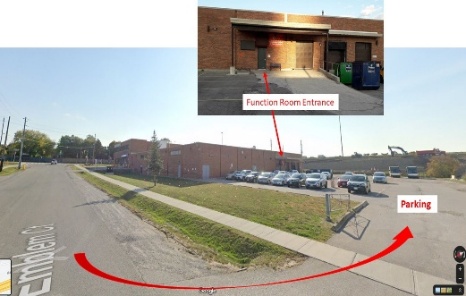
Function Room at Centre for Immigrant and Community Service (CICS), 2330 Midland Ave, Scarborough, ON, M1S 5G5. See the below photos for the entrance door (green door) to the Function Room and the Parking Lot.
TOPIC: Waste Heat as an Asset?
PRESENTER: Mike Hassaballa, P. Eng.
WHERE: Hybrid Format
- In-Person: Function Room at Centre for Immigrant and Community Service (CICS), 2330 Midland Ave, Scarborough, ON, M1S 5G5. See the below photos for the entrance door (green door) to the Function Room and the Parking Lot.
- Virtual: Zoom Video Conferencing. Zoom link will be provided later.
REGISTRATION: Follow the link
Agenda
5:45 pm Registration and Networking
6:00 pm Welcome message
6.05 pm Introduction
6:10 pm Presentation
7:00 pm Q&A
7:15 pm Vote of Thanks and Conclusion
About the Presenter:
Mike Hassaballa is a mechanical engineer with H.H. Angus and Associates Ltd., where he is involved in energy infrastructure advisory and consulting services with a focus on district energy, electrification readiness, high performance efficient buildings, and complex thermal systems. His work includes the technical and strategic evaluation of buildings including central plants, heat recovery opportunities, thermal storage, heat pump applications, and energy transition pathways for institutional, commercial, and large campus environments. Mike has contributed to a range of projects involving energy infrastructure planning, system optimization, and the development of practical decision support for clients facing aging assets, rising energy costs, and carbon reduction targets. He is particularly interested in the intersection between engineering fundamentals and real-world project decision making, including how technical choices translate into long term operational, financial, and infrastructure outcomes.
Synopsis of the Topic:
Waste heat is often treated as an unavoidable loss within buildings and energy systems, but in many cases, it can be recovered, upgraded, and used to improve overall system performance. This presentation will provide a practical engineering overview of waste heat recovery, including what waste heat is, where it is commonly found, and how its quality and temperature level influence recovery potential. The session will review both passive and active recovery approaches, including heat exchangers, heat recovery chillers, heat pumps, energy recovery systems, and thermal storage integration. It will also discuss real project applications and the technical conditions that tend to determine feasibility, such as source stability, temperature lift, distribution requirements, load matching, and economics. The objective is to give engineers a structured framework for thinking about waste heat, not only as a sustainability concept, but as a practical design and decision-making opportunity.